SCHOOL FLOORING: Getting it right before the term starts
Updated: Aug 4
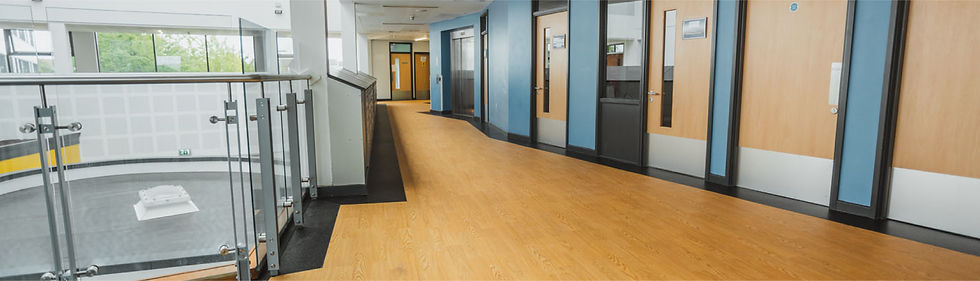
Most of what makes a school floor succeed or fail is decided long before anyone turns up to lay it. A school can't close for a fortnight while the work gets done. The window is usually the summer holidays, sometimes a half term, and the building has to be ready for the first morning back whatever happened in between. Miss that and you're not inconveniencing a few people, you're disrupting a whole school's return.
That deadline is the real test in education work, and you don't meet it by working fast once you're on site. You meet it with the decisions made first: what each space needs, which materials suit it, and what state the subfloors are in once the old flooring comes up. Get those right and the installation runs to plan. When they're wrong, the holiday window is where it surfaces, and there's no slack left to recover. We wrote more broadly about why understanding a sector changes how you approach the work, and schools are the clearest case of it.
School flooring isn’t for just one space
Part of getting the timing right is knowing, before you start, that you're not laying one floor. A secondary school can run from a sports hall to a science lab to a quiet SEN room within a few corridors, and each asks something different.
Circulation routes, entrances and dining areas need a hard-wearing surface that stays safe when wet, which usually means safety vinyl with the right slip rating. Classrooms and breakout zones often do better with carpet tiles or needlepunch, partly for warmth and partly because they take the edge off noise, and a quieter room is an easier room to learn in. Specialist spaces bring their own requirements again, whether that's chemical resistance in a lab or a calm, predictable finish in a sensory room. Working all of that out in advance is what lets the programme run cleanly when the clock's against you, rather than finding a mismatch halfway through the holidays. You can see how it plays out across our education projects.
Safety, and the things that sit alongside it
Slip resistance is the obvious safety point, and it's non-negotiable in wet and high-traffic areas. The floor also has to work for children who use the building differently. Level thresholds and proper transitions matter for wheelchair users and anyone less steady on their feet. For students with sensory needs, the finish itself is part of the environment, so a calm, consistent floor that doesn't glare or distract does real work in helping a room feel manageable. None of this can be sorted on the fly in a tight window, which is why it belongs in the planning rather than the install.
Durability is won before the floor goes down
A school floor is expected to last well over a decade, often inside a lifecycle maintenance programme run by the local authority or an FM provider. The material matters, but the part that decides whether a floor reaches that age is usually the subfloor preparation underneath it. Cutting time on uplift and smoothing to claw back a day is exactly the shortcut that comes back as a failed floor in year three, long after the contractor has gone. We've written before about why the planning stage carries the project, and in a school it's also what protects the deadline, because a subfloor problem found late is the thing most likely to blow the window.
What it looks like in practice
Our ongoing work at Winifred Holtby and Tweendykes School is a fair picture of this. It's a dual-campus site, mainstream secondary alongside an SEN school, with around 3,000sqm of flooring being replaced zone by zone across classrooms, corridors and breakout areas. All of it happens during the holidays, with goals agreed and realistic well in advance. We uplift the old finishes, prepare the subfloors, then install safety vinyl through the circulation areas and needlepunch carpet tiles in the quieter spaces, phasing the work so the school comes back each term to upgraded rooms and none of the mess that produced them.
That's what education work is really judged on. Whether the school got the building back on time and ready to use, with nobody losing a teaching hour to it, and whether the floor's still doing its job several years on. How it looked on the first morning matters less than either of those.
That's the standard education work is really judged by. Not entirely on how the floor looks on the first day, but whether it was delivered without anyone losing a teaching hour to it, and whether it's still doing its job several years on.
If you're planning flooring for a school and want to talk through what your specific spaces need, get in touch.


Comments